Littlebit Labs
Built by engineers who felt the pain.
Why we built Minimal
The least interesting problems.
The most interesting engineers.
Our frustration was never with the tools. Every framework, every ORM, every API library works exactly as designed. The problem is what that design requires of the engineers who use it. We watched this across every team we worked with: engineers entirely capable of radical thinking, permanently occupied instead with infrastructure. Writing routes. Maintaining access layers. Duct-taping the stack every time the schema changed. Not because they chose to — because nothing in the toolchain freed them from it. The engineers capable of the most interesting work in the room were spending their time on the least interesting problem in the codebase. No existing tool was designed to change that. That is what drove us to build Minimal.
The engineers we worked with were not lacking ideas. They were lacking hours. Minimal is built on a simple belief: free an engineer from the ninety percent that was never worth writing, and you do not get a more productive engineer — you get a completely different one. One who can actually think, actually experiment, actually innovate. What teams will build when the infrastructure takes care of itself — that is what we cannot wait to see.
The goal from the start was an infrastructure layer — one that removed the pain of traditional backend development at its root, not per project. The system that emerged could serve seventy percent of every API surface automatically, from the schema, without a line of code written or owned. When AI arrived, the picture became complete. Natural language layered on top of what we had already envisioned could resolve another ten to twenty percent through conversation. The last ten percent — logic genuinely specific to each product — has always belonged to the engineers who understand it. Minimal does not try to automate all of it. It removes the ninety percent that was never worth writing in the first place, so the ten percent that is gets the engineering attention it deserves.
The team
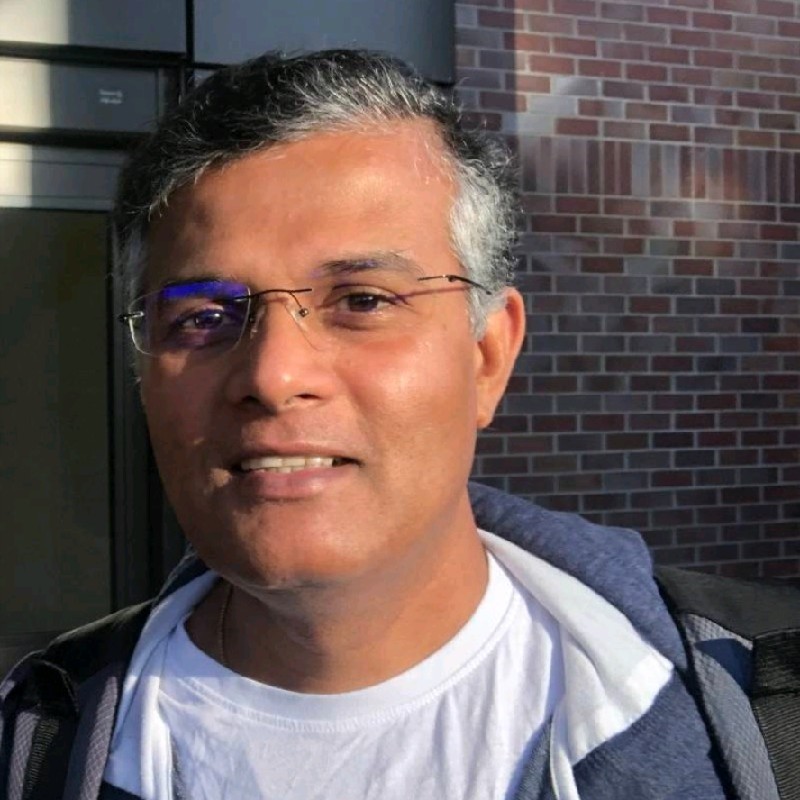
Harish S S
Co-Founder and CEO
Harish is co-founder and CEO of Littlebit Labs and the inventor of the inline compiler for meta-logic at the core of Minimal.
He spent close to three decades at HPE, VMware, Walmart, and Cyware — across telecom infrastructure, fraud detection, fleet management and GPS systems, datacenter engineering, virtualisation control planes, and petabyte-scale data processing.
At HPE, as Expert, he invented four components of a datacenter-scale OS deployment system. A hardware-agnostic bootable OS volume writable to any disk on any hardware. A proximity equation for identifying server neighbours across availability zones, floors, and buildings — integer arithmetic, no floating-point unit required, 54x faster than Haversine's formula. A rack-level broadcast protocol that assembles OS images from neighbouring machines over the top-of-rack switch, deploying an entire server fleet in under ten seconds. A versioning layer that stores OS state as git-style bit blocks, recoverable by reboot to any point in time. Four patents record this work — each one a refusal to accept that the conventional answer is the right answer.
At VMware, as Senior Staff Engineer, he owned the virtualisation control plane — the technology layer running beneath thousands of enterprises at global scale. At Walmart, as Distinguished Engineer, he set the technical direction for petabyte-scale data systems. At Cyware, as Fellow — the top of the individual contributor track — he defined the security infrastructure architecture.

Gowthaman Dhamodharan
Co-Founder and CTO
Gowthaman spent twenty-two years building the infrastructure that enterprises depend on — telecom network elements, datacenter management systems, cloud observability platforms. At HPE, VMware, and Broadcom, he was not the engineer who used the infrastructure. He was the one who built it.
At VMware, as Staff Engineer, he designed Cloud Observability from scratch for VMware Cloud — the system responsible for monitoring, assessing, and remediating service degradation across one of the world's largest cloud environments. It collects billions of metrics and streams them to analytical platforms. The entire service runs under 40MB of total JVM memory and 8% of one vCPU. He did not inherit those constraints. He chose them. He also owned the automation platform across thousands of VMware SDDCs — and built the outage detection system that correlates events across AWS availability zones to assess impact the moment it begins.
His engineering philosophy is ruthlessly performance-first.

Kavita K S
Co-Founder and COO
Kavita runs the operational backbone of Littlebit Labs — legal, finance, compliance, HR, and organisational design. She is also the team's most demanding validator. Every feature, every release, every customer-facing change passes through her before it ships. Her standard is not "does it work in the demo" — it is "does it work for someone who has never seen it before, on a database they set up themselves, in conditions we did not anticipate." If Kavita signs off, the team ships with complete confidence. She is the reason Minimal's reliability is not a claim. It is a track record.
Production proof
We did not build this for someone else's stack.
Before any external customer used Minimal, we ran it ourselves. The Dialer App — 3.8 million downloads, approximately one million events per day — runs on Minimal in production. Every schema change, every upgrade path, every runtime surprise: we found them first.
Infrastructure software earns two things before a customer boards: smooth upgrades, and scars from production. Minimal has both.